<?xml version="1.0" encoding="utf-8"?><feed xmlns="http://www.w3.org/2005/Atom" ><generator uri="https://jekyllrb.com/" version="3.10.0">Jekyll</generator><link href="https://craigdsouza.in/feed.xml" rel="self" type="application/atom+xml" /><link href="https://craigdsouza.in/" rel="alternate" type="text/html" /><updated>2026-05-04T11:52:50+00:00</updated><id>https://craigdsouza.in/feed.xml</id><title type="html">Craig Dsouza</title><subtitle>Writing on technology with a focus on India</subtitle><author><name>Craig Dsouza</name></author><entry><title type="html">The Biggest Science Experiment Waiting to Happen</title><link href="https://craigdsouza.in/writings/2026/03/30/the-biggest-science-experiment-waiting-to-happen" rel="alternate" type="text/html" title="The Biggest Science Experiment Waiting to Happen" /><published>2026-03-30T00:00:00+00:00</published><updated>2026-03-30T00:00:00+00:00</updated><id>https://craigdsouza.in/writings/2026/03/30/the-biggest-science-experiment-waiting-to-happen</id><content type="html" xml:base="https://craigdsouza.in/writings/2026/03/30/the-biggest-science-experiment-waiting-to-happen"><![CDATA[<h1 id="the-ai-that-grew-a-tomato">The AI that grew a tomato</h1>
<p>On the 30th of December, 2025, a U.S. resident Martin DeVido based in Boise, Idaho sowed a tomato seed. Not outdoors, the frigid winter weather doesn’t allow tomatoes to grow outdoors in Idaho. He sowed this seed in an indoor environment. He then gave Claude, Anthropic’s AI model, full control over the physical environment that the plant could grow in. Claude could control via physical actuators the plant’s exposure to light, its soil temperature, water availability, humidity and airflow. Claude also had inputs, via a camera that photographed the plant, CO2 sensors, RH sensors, air and leaf temperature sensors, soil moisture sensors.</p>

<p>Claude has a rich in-built knowledge about the mechanisms by which plants grow . <strong>CO2 uptake</strong> It knows that plants take up atmospheric CO2 and turn it into sugars. Ambient air is ~420 ppm of CO2; in an indoor environment, a fruiting tomato depletes this fast. Claude tracks it and injects CO₂ to keep photosynthesis running at full rate.<strong>Vapour pressure deficit</strong> Vapour pressure deficit measures the difference between the amount of water vapour the air can hold at a given temperature vs the amount it actually holds. If VPD is too low, in humid/cold environments, no transpiration occurs, the plants don’t circulate water and nutrients from the soil to the air and thus growth is less than optimal. If VPD is too high, in very dry/hot conditions, the plants stomata close and no transpiration takes place. Claude understands that managing air temperature, humidity and air flow can bring VPD to a sweet spot. <strong>Stomata regulation</strong> - Stomata, the tiny openings on a plant’s leaf that let water and air in and out also open and close depending on the difference in air and leaf temperature. If maintained optimally the stomata can be kept optimally open for plant growth.</p>

<p><strong>Root zone enzyme activity</strong> Enzymes in the root zone are responsible for helping plants absorb nutrients. In cold weather, even if the soil has adequate nutrients, uptake can be slow. Claude tracks root zone temperature and maintains it for optimal absorption. <strong>Root zone moisture</strong> nutrient uptake is also affected by presence of soil moisture that is either too high or too low. Claude tracks soil moisture with probes and maintains it in an ideal window with pulses of irrigation. <strong>Photosynthesis</strong> light is a crucial input providing energy to the plant to produce sugars. In certain periods of growth more sunlight or artificial light can in fact increase photosynthesis and fruit production. Claude can track and schedule ON/OFF cycles of light and its intensity. <strong>Thigmomorphogenesis</strong> this was will amaze you, plants that are subject to windy weather are triggered to produce thicker stems to withstand the wind. These thicker stems in turn can support larger fruits growing on them. Claude knows this too and can provide a controlled air stream to induce thigmomorphogenesis. You get the picture!</p>

<p>A critical thing to note here is that the maintenance isn’t weekly or daily as it is with many agricultural systems. Claude maintains these variables in their optimal range by checking in on their values every 30 min. Moreover, the results from experiments like this show just how many challenges farmers are up against when growing on open fields. None of the variables are really under their control other than irrigation scheduling. Just as in Idaho the temperature is too cold for plant growth in winter, in much of India it is often too hot and summer crops are adversely affected by this.</p>

<p><a href="https://www.youtube.com/shorts/IEZY8bASy9Y">Watch: Claude grows a tomato</a></p>

<h1 id="what-if-claude-grew-100-tomatoes">What if Claude grew 100 tomatoes</h1>
<p>Claude can learn only so much from one experiment growing a single tomato plant though. What if it grew 100 plants and tried something slightly different in each case? 100 experiments could mean many times more learnings and at a faster pace than a single run. Perhaps when learnings occur at this pace, we could rapidly increase the quantum and diversity of food production while at the same time reducing our material footprint(water and energy) and growing farmer incomes as a result.</p>

<p>This is the real world equivalent of the accelerated learning that is happening in AI data centers everywhere. In the case of Large Language Models (LLMs like ChatGPT) learning and improving requires more text data. The text of the internet - all the literature that has ever been written about agriculture and plant growth - is only adequate as a starting point though. The learnings possible through literature saturate and experiments are necessary. In some domains such as robotics, a first step might be experiments in simulated environments (i.e. think virtual robots learning to walk). In domains such as agriculture too this might be possible. But all experiments must eventually move to the physical world. In this scenario, human beings can serve as the labour measuring inputs given to Claude and changing temperature , humidity etc via controls as per Claude’s instructions. This is only likely to slow down the pace of experiments, albeit in the short run it might be necessary, to avoid the costs of Sensors and actuators. Either way, this appears to be an experiment just waiting to be done and the effects of its outcome on agriculture, especially in the developing world are likely to be very consequential.</p>

<p>The fast growth of polyhouse based agriculture in India, is a tailwind that can only help make this more likely than not.</p>

<h1 id="business-models-and-who-holds-the-ip">Business models and who holds the IP</h1>
<p>1) perhaps it is seed companies that do the experiments , not farmers, they certainly have the capital. They could perform 100 or even a thousand experiments with their seedlings and the results (the Intellectual Property) could become a recommended guidance to farmers on how to grow from sowing to appropriate harvest time. To ensure a return on investment they could charge a premium for seeds + guidance.
2) alternatively it isn’t seed companies but infrastructure companies that, they build custom physical infrastructure ideally suited for fitting out with sensors and actuators. They could also provide the AI model which observes and controls the growth experiments and generates them IP. More the number of farmers , more the experiments and thus more valuable the IP. These companies business model is thus to ensure farmers a given return. They control the production and thus know the likely tonnage. The market price is always volatile though and thus they keep a larger margin in return for taking on the risk.
3) lastly, perhaps it is a farmer co-operative, that purchases the physical infrastructure from companies that only build , and don’t operate them. Instead farmer co-operative themselves operate this collective infrastructure. Practically it means that the co-operative hires specialized employees who understand this infrastructure and can advise farmers on how to maintain it. They play a role similar to the private company, but in a co-operative structure. In this case, if it succeeds , its likely that farmers get to keep a larger part of the profits, but they in turn take on a larger share of the risk of market price fluctuations.</p>

<p>It remains to be seen which model will eventually succeed, perhaps none of the three and something else entirely.</p>

<h1 id="supply-and-demand">Supply and Demand</h1>
<p>I have so far largely talked about growing supply, i.e. better control of agricultural plants inputs can serve to increase production. However increased production doesn’t guarantee the economic well being of farmers. Market demand fluctuations could easily move price downwards and erode away the benefits of increased production. This problem isn’t solved by farmers growing more of the same thing but growing more of many different things. The same rule that applies in entrepreneurship applies here. If you have an undifferentiated product in a competitive market your margins are tight and total income is at the mercy of market demand. This is true for millions of farmers in India who are growing the same product (rice, wheat) for near zero margins. They do this however because they know that the market demand for rice exists. They don’t really know if the demand for gooseberry does. Polyhouse AI aided experiments as we’ve discussed could help reduce this risk by increasing the tonnage produced per rupee input. This helps cushion any price volatility and ensure good incomes. A world in which farmers produce 100 different crops and thus compete less against each other is one that’s economically better for them rather than the current world in which the large majority of farmers produce only ~5 different crops.</p>]]></content><author><name>Craig Dsouza</name></author><category term="AI" /><category term="agriculture" /><category term="food" /><summary type="html"><![CDATA[The AI that grew a tomato On the 30th of December, 2025, a U.S. resident Martin DeVido based in Boise, Idaho sowed a tomato seed. Not outdoors, the frigid winter weather doesn’t allow tomatoes to grow outdoors in Idaho. He sowed this seed in an indoor environment. He then gave Claude, Anthropic’s AI model, full control over the physical environment that the plant could grow in. Claude could control via physical actuators the plant’s exposure to light, its soil temperature, water availability, humidity and airflow. Claude also had inputs, via a camera that photographed the plant, CO2 sensors, RH sensors, air and leaf temperature sensors, soil moisture sensors.]]></summary></entry><entry><title type="html">Why Business owners need to understand agents</title><link href="https://craigdsouza.in/writings/2026/03/11/why-business-owners-need-to-understand-agents" rel="alternate" type="text/html" title="Why Business owners need to understand agents" /><published>2026-03-11T00:00:00+00:00</published><updated>2026-03-11T00:00:00+00:00</updated><id>https://craigdsouza.in/writings/2026/03/11/why-business-owners-need-to-understand-agents</id><content type="html" xml:base="https://craigdsouza.in/writings/2026/03/11/why-business-owners-need-to-understand-agents"><![CDATA[<h2 id="what-are-agents">What are agents?</h2>
<p><img src="/img/posts/2026-03-11-why-business-owners-need-to-understand-agents/agents-blog-header-blueprint-quilt-mixed-media.png" alt="" /></p>

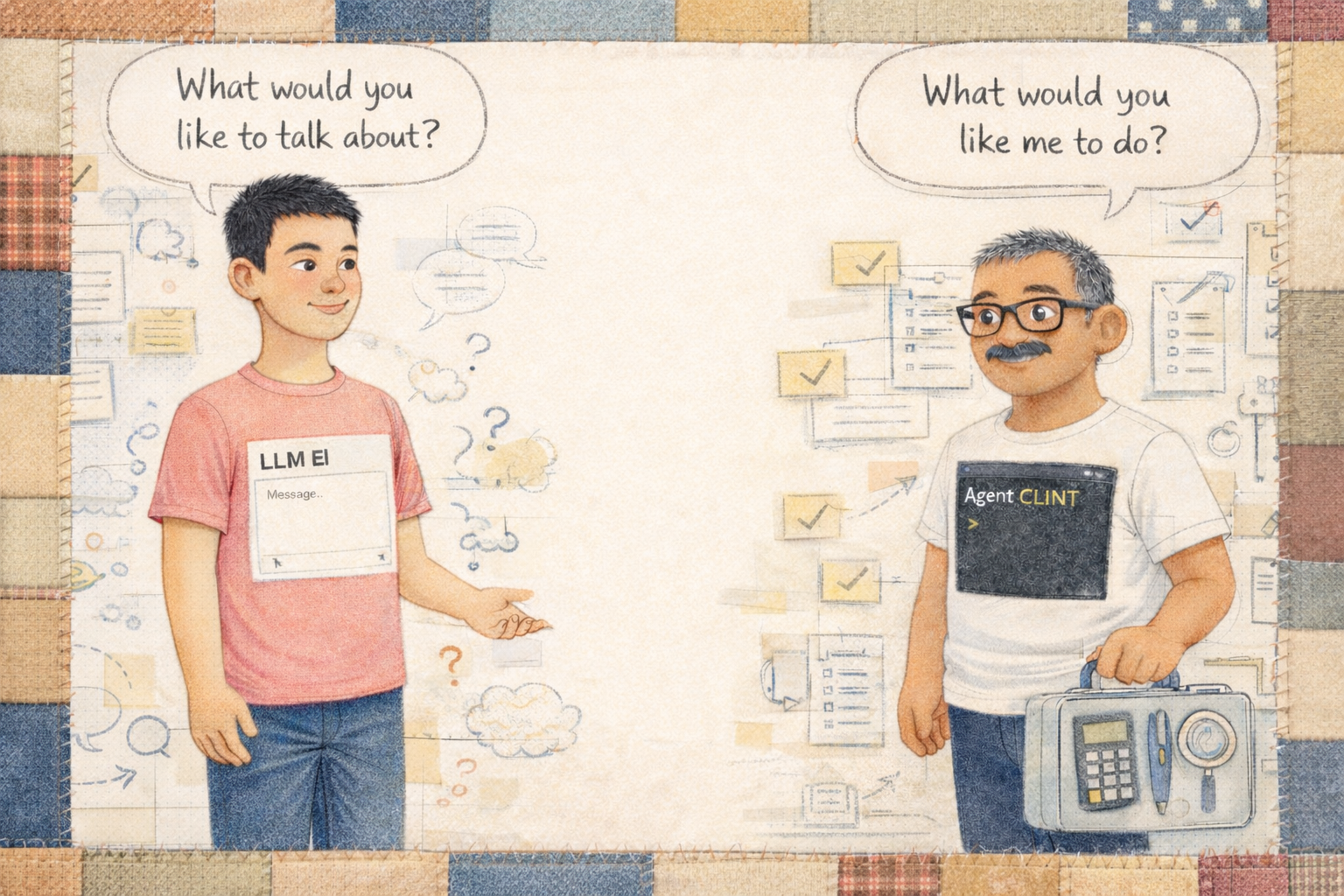
<p>If you’re reading only popular traditional media outlets on AI, you know something is happening, but you’re unsure of what. You know you’re being told your industry could be disrupted, but as a business owner , you’re not being advised what you can do to avoid being disrupted. You’ve probably heard of chatGPT. You may even be using this and other language models to frequently answer your queries. If that’s all your doing I’m afraid to say you’re only scratching the surface. I’m here to tell you that you need to understand <code class="language-plaintext highlighter-rouge">Agents</code>. What are agents? They’re simply language models (probabilistic) paired together with deterministic tools. You see, language models are creative. Their creativity is an essential ingredient in their problem solving ability. However at times the lines between creative answers and wrong answers get blurred. This makes LLMs by themselves unstable. They need a <em>harness</em> , i.e. tools that are deterministic in nature that LLMs can use to produce outputs with greater accuracy.</p>

<h2 id="what-can-agents-do-today">What can Agents do today?</h2>

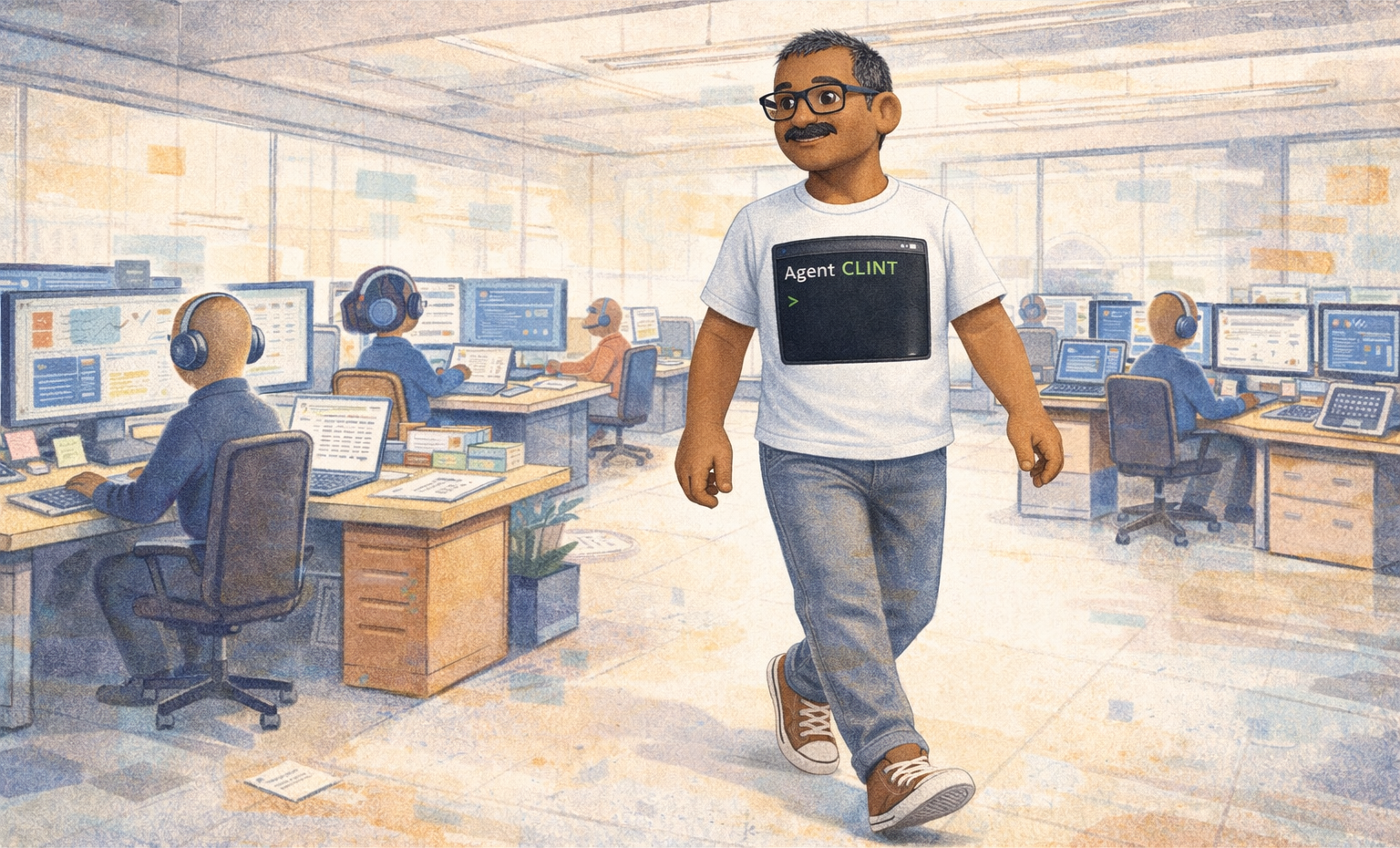
<p>AI has changed and with it our understanding of the term must evolve. From 2022-2023 AI primarily meant chatbots like chatGPT. Since 2024, AI came to mean Agents, more specifically Agents developed for Programming. Since the turn of 2026, its clear that AI and <code class="language-plaintext highlighter-rouge">Agents</code> mean something more. Agents aren’t only programming, they’re engineering software - from architecture design to development and testing. Early adopters are already seeing results of early experimentation with Agents. Some companies are deploying Agents to full-time deployment.  The Pune edition of the <a href="https://hasgeek.com/fifthelephant/2026-pune/">Fifth Elephant Conference</a> (February 27-28th), organized by Hasgeek at Nutanix’s Hinjewadi campus was one such event that saw many early adopters congregate together.</p>

<p><img src="/img/posts/2026-03-11-why-business-owners-need-to-understand-agents/clint-open-floor-office-v1.png" alt="" /></p>

<p>Nearly every technology company now uses AI agents for code generation, the number one use case. This means using AI to develop new product prototypes and even launch features. That isn’t sufficient though. If your product team is launching new features everyday your QA team needs to keep up. Manas Chaturvedi from IDfy (risk evaluation and fraud detection) talked about how their QA teams began using AI agents to write and maintain tests for software, relegating their QA engineers to a more supervisory role.</p>

<p>Prasanth Jayaprakash (Equal Experts) shared how their team built a lead generation system from scratch, not using agents , but using AI to accelerate software development for the pipeline. Neha from the retail company Target described how Agentic Generative AI (aided by classical Machine Learning) is helping validate and enhance item data (i.e. products sold by Target) including marketing description and images.</p>

<p>It wasn’t only software companies. Himanshu Agrawal from Johnson Controls talked about experiments in having the operations of buildings - lighting, energy generation, HVAC etc. orchestrated by AI agents. These agents are fed data - sensor telemetry readings, building plans and more and given an objective. The agents software architecture allows it to reason over this data, develop hypotheses and propose preventive maintenance or work orders.</p>

<h2 id="evaluating-the-work-of-agents">Evaluating the work of agents</h2>
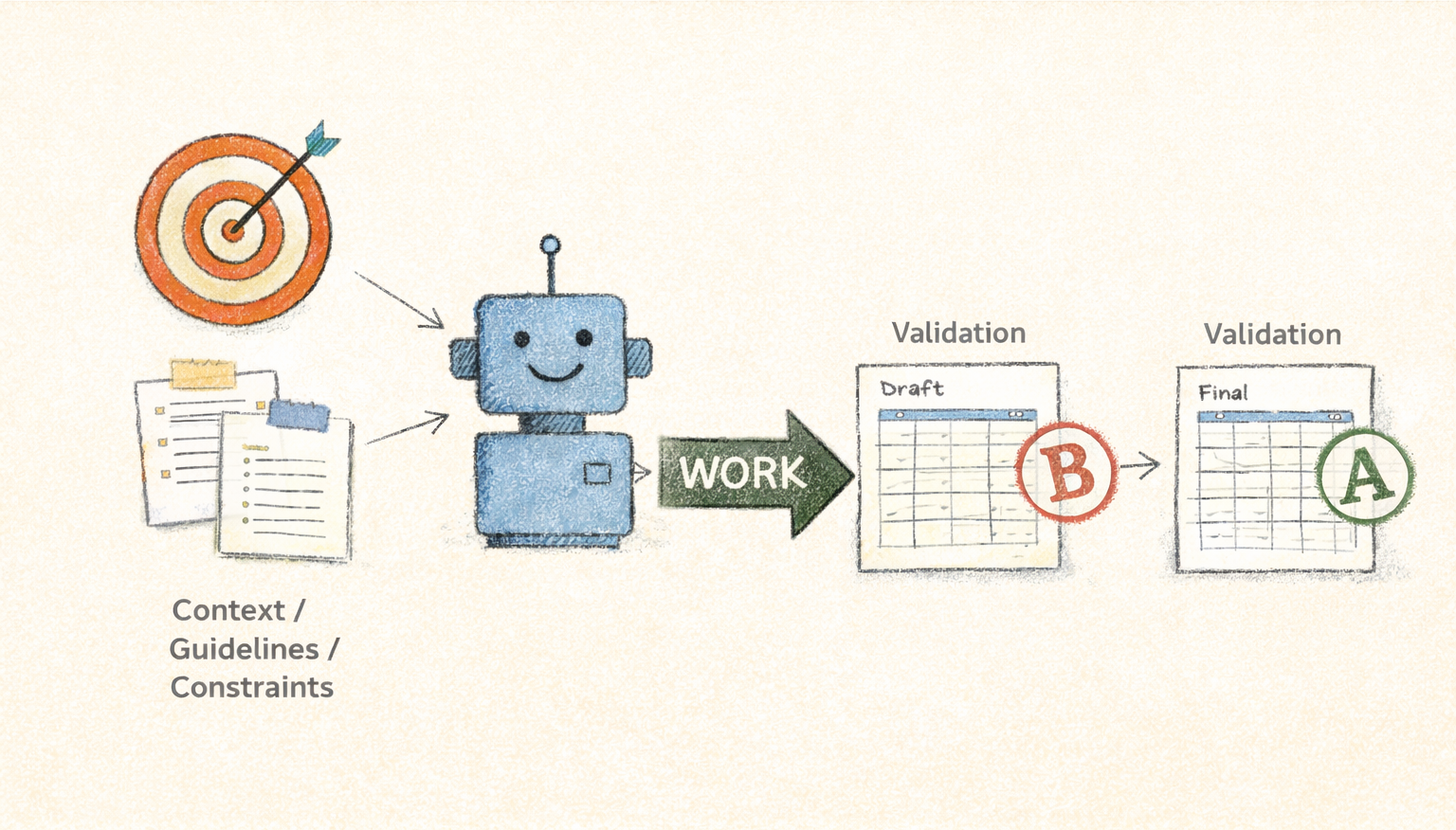
<p>Having said this, the agents we’re talking about are still better thought of as toddlers, they need hand-holding. Eventually you can expect them to outdo us but at this stage, you should expect them to make mistakes every once in a while. Thus our role as agent-builders is to 
1) give the agent a goal, preferably a measurable goal and a metric for it to know if it has accomplished the goal or how close it is to doing so. 
2) to provide assistance in the form of context, guidelines and sometimes hard constraints. This one gets less relevant over time as the AI models that power AI agents get more intelligent.</p>

<p><img src="/img/posts/2026-03-11-why-business-owners-need-to-understand-agents/agent-workflow-validation-v4.png" alt="" /></p>

<p>As <a href="https://atharvaraykar.com/">Atharva Raykar</a>, from Nilenso (a tech co-operative) talked about, “to prevent errors from compounding” we need to design the agents workflows as multiple units of work , gated by mechanisms to verify correctness of the output at each stage. Evaluation was a running theme through the talks. Himanshu put it as “the LLM only proposes (building controls)”, the system validates. <a href="https://theclarkeorbit.github.io/pdfs/causality_fifthel_pune2026.pdf">Prasanna Bhogale</a> (Romulan AI) described how encoding the knowledge of professionals down (as causal graphs) can ensure AI agents don’t fall into a trap of confusing correlation with causation. In a hands-on session, Kiran Kulkarni and Utkarsh Dighe (unravel.tech) in a <a href="https://github.com/unravel-team/real-agents-workshop">hands-on session</a> showed how we don’t have to come up with the perfect prompt to chat with AI. We can have AI agents optimize on different prompt styles until a metric we care about is maximized.</p>

<h2 id="agents-for-domains-outside-software">Agents for domains outside software</h2>

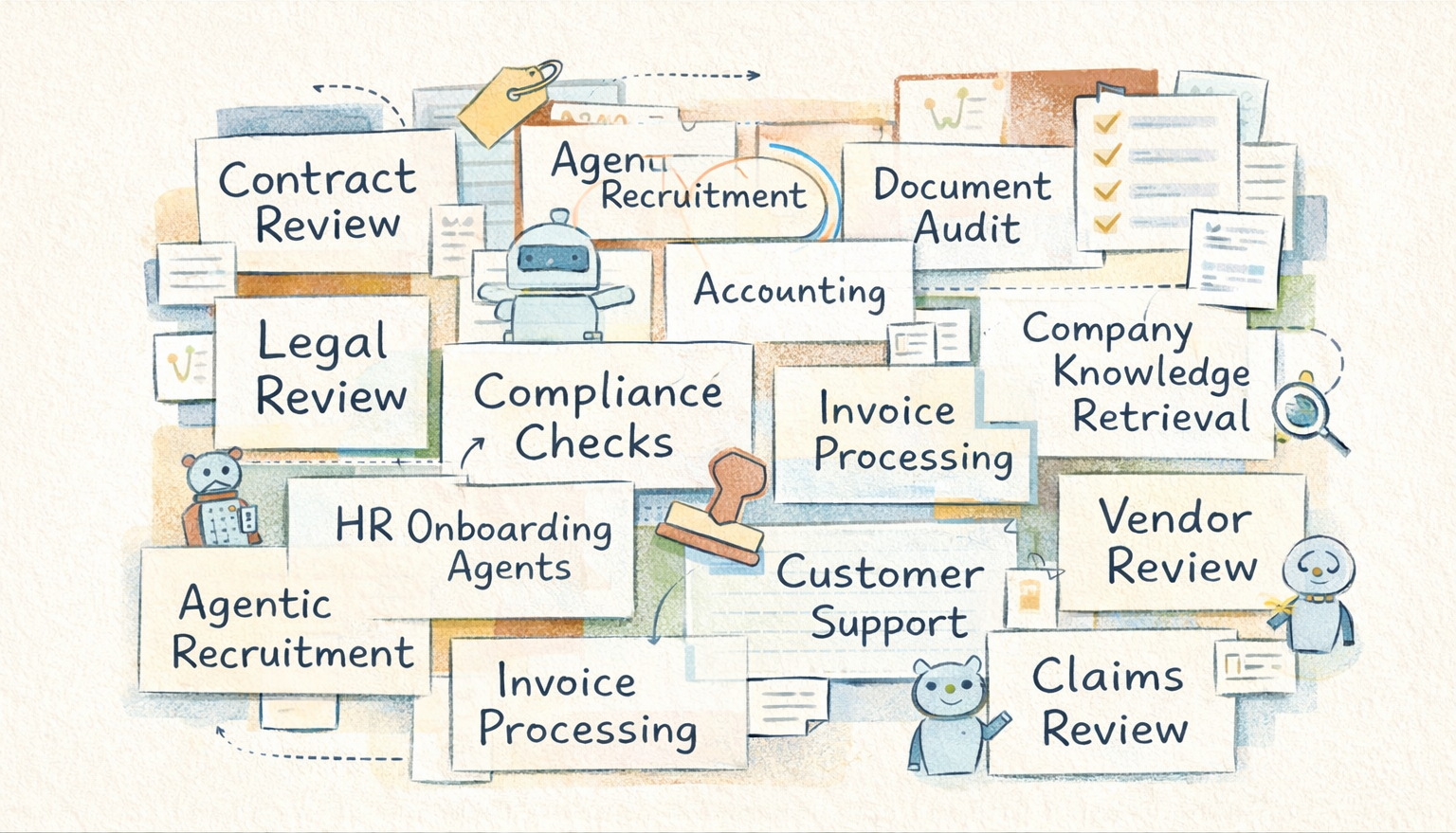
<p>Ok, but wait, what if you’re not a technology company? What if most of your employees don’t write code? Does AI still have relevance for you? Absolutely yes! Your team may not write code but you still have institutional knowledge , workflows and Standard Operating Procedures (SOPs). Let’s say that you are a law firm. A part of your work is reviewing contracts. You have a standard template that you expect the contracts to be in. You can ask an Agent to review the contract that you’ve received against the standard template and flag any deviations, in plain English. Without agents you would have either had a para-legal spend hours reviewing the contract in detail or hired a software developer to automate the scanning of the contract.</p>

<p><img src="/img/posts/2026-03-11-why-business-owners-need-to-understand-agents/non-tech-ai-agents-wordcloud-v1.png" alt="" />
Agents are inherently doers and the breadth of their inbuilt skills is vast. But agents don’t necessarily understand company context. That’s where SKILLS come in.</p>
<h3 id="skills">SKILLS</h3>
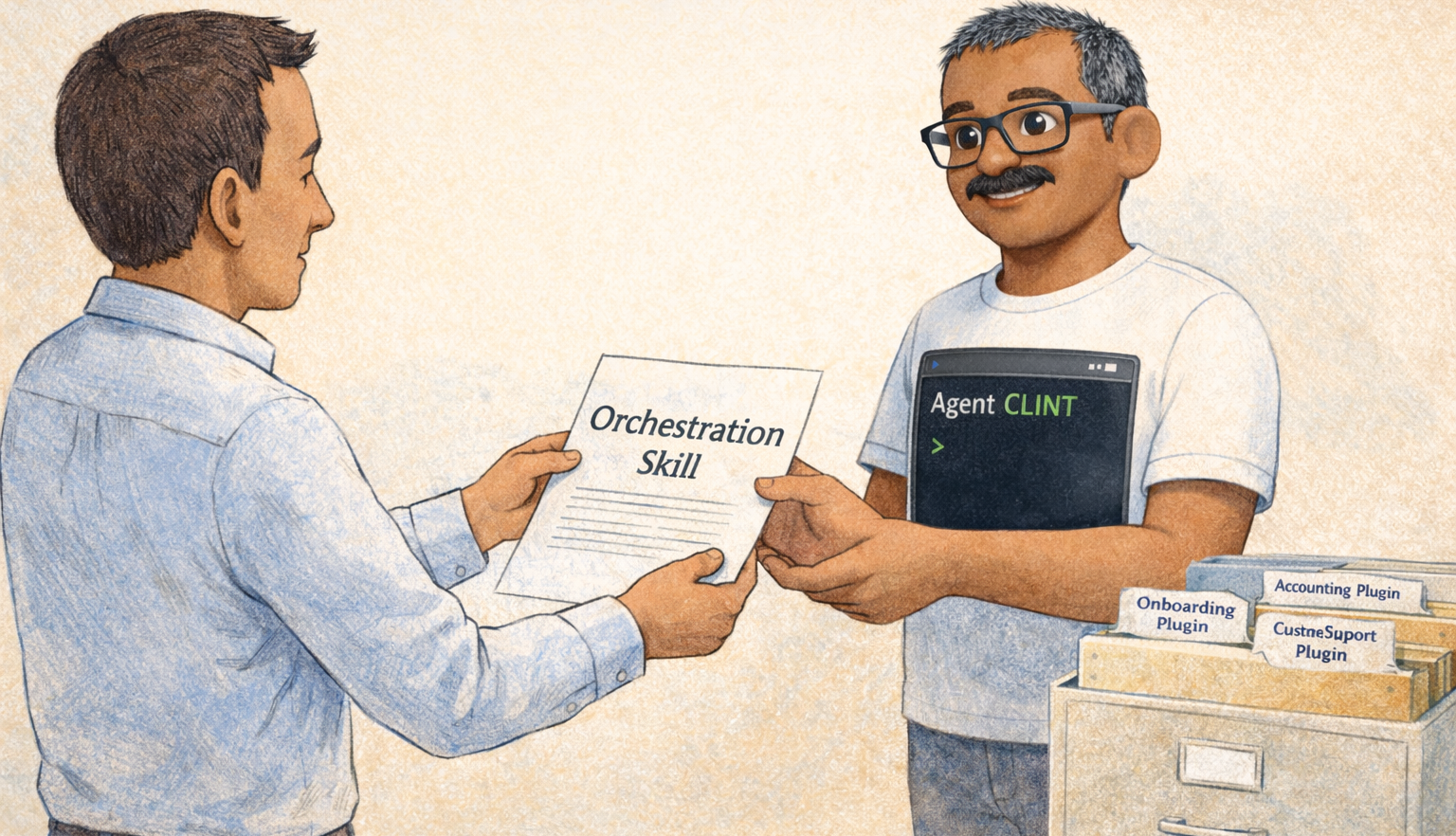
<p>The primary UI through which you might leverage agents is through Claude’s Co-Work, Google’s Anti Gravity or Open AI’s Codex which all teach the concept of Agents with customizable SKILLS. These SKILLS are nothing but simple markdown (plain-text) documents where you store objectives, detailed guidelines, SOPs, and hard constraints written down in plain English. This way if you have a process that repeats but isn’t the same every-time, you would write it up as a SKILL to save employees time. They can simply invoke a SKILL instead of repeating instructions. Agents in Claude for instance can use SKILLs once invoked to manipulate documents in most popular formats, Word, Spreadsheets, Slides. They can also connect to most popular Cloud services. Anyone can write up a SKILL document, but you would typically take the assistance of AI in a chat interface to write it up.</p>

<p>A SKILL is not simply a software program written in human language. Its much more. SKILLs are inherently flexible. This means that if we give an Agent a SKILL document for instance with guidance on how to fetch data from a particular website and the guidance in the document doesn’t match the reality the Agent is able to understand the higher level objective described in the SKILL and find other ways to achieve the objective.</p>

<p><img src="/img/posts/2026-03-11-why-business-owners-need-to-understand-agents/skills-plugins-handoff-v1.png" alt="" /></p>
<h3 id="plugins">Plugins</h3>
<p>Often times problems are complex enough that sub-processes can be defined. These problems then require multiple SKILLs rather than a single one. A simple example is the work of a marketing team. Marketing involves working with material that goes onto different surfaces (website, product, brochure, social media etc). This involves review of copy and images for brand consistency and technical aspects, such as dimensions. The collateral then has to be repurposed for each surface. SKILLs can come in at each stage, whether review or repurposing. This leaves the marketing team to focus simply on the ensuring the Agent is optimizing for the correct metric, one that is relevant for the business. This is where human judgement and accountability is important. Agents might even choose metrics in some cases, but in the end a human is accountable.</p>
<h2 id="conclusion">Conclusion</h2>
<p>This is just the beginning. AI Agents are beginning to prove their usefulness in less technical domains of knowledge work. You can think of agents as being packaged expertise of specialists that can be run by generalists. A well organized business, empowered by agents can now take on the work of 100 people with a team of 10. Many projects previously thought of as impossible or economically infeasible now become possible with agents. Their implementation can amplify the business’s top line and optimize its bottom line.</p>

<p>The bottleneck no longer is expertise, its judgement. So what are you going to have your agents build?!</p>]]></content><author><name>Craig Dsouza</name></author><category term="AI" /><category term="agents" /><category term="business" /><summary type="html"><![CDATA[What are agents?]]></summary><media:thumbnail xmlns:media="http://search.yahoo.com/mrss/" url="https://craigdsouza.in/img/posts/2026-03-11-why-business-owners-need-to-understand-agents/agents-blog-header-blueprint-quilt-mixed-media.png" /><media:content medium="image" url="https://craigdsouza.in/img/posts/2026-03-11-why-business-owners-need-to-understand-agents/agents-blog-header-blueprint-quilt-mixed-media.png" xmlns:media="http://search.yahoo.com/mrss/" /></entry><entry><title type="html">Hello again</title><link href="https://craigdsouza.in/writings/2026/03/05/hello-again" rel="alternate" type="text/html" title="Hello again" /><published>2026-03-05T00:00:00+00:00</published><updated>2026-03-05T00:00:00+00:00</updated><id>https://craigdsouza.in/writings/2026/03/05/hello-again</id><content type="html" xml:base="https://craigdsouza.in/writings/2026/03/05/hello-again"><![CDATA[<p>This site has been dormant for a few years. I’m bringing it back — not as an archive, but as a working space.</p>

<p><strong>What this space is for:</strong></p>

<p><em>Writings</em> will be shorter pieces — things I’m thinking through, insights I’ve figured out, ideas I want to test by putting them into words.</p>

<p><em>Reports</em> will be longer, more structured. I’ve been experimenting with AI-assisted research and want to document what that produces when done carefully.</p>

<p><em>Tools</em> will be small utilities or sometimes something bigger I build that might be useful to others.</p>

<p><strong>What I’m working with:</strong></p>

<p>If something here is useful or you want to connect — my email is on the <a href="/resume">Resume</a> page.</p>

<p>More soon.</p>]]></content><author><name>Craig Dsouza</name></author><category term="meta" /><summary type="html"><![CDATA[This site has been dormant for a few years. I’m bringing it back — not as an archive, but as a working space.]]></summary></entry></feed>