TLDR; Too many businesses are caught up in the hype of AI Automation. Automation can be a net negative if you don’t do it right. Before automating anything, it’s important to identify the right process to automate. This explainer provides a framework to find where your business pipeline is constricted and thus most in need of optimization and perhaps automation. Then, within that stage, you can prioritise by probable impact on cash flow first and time to impact second.
Cash is King
This post is centered around the idea that cash flow is central to business. A healthy business is one with positive and growing cash flows. If one were to apply automation in a business, a natural goal would be to increase , or at minimum protect those cash flows.
Depending on the business however, the bottleneck to these cash flows could be in different parts of the business pipeline. For instance, a retailer with strong foot traffic but a clunky checkout experience is losing cash at the payment stage, better marketing will not help. A service business that closes every lead it gets but struggles to retain clients beyond the first engagement has a support and delivery problem, not a sales problem. A wholesale supplier with loyal customers and healthy margins but chronic late payments has a collections problem, not a fulfillment one.
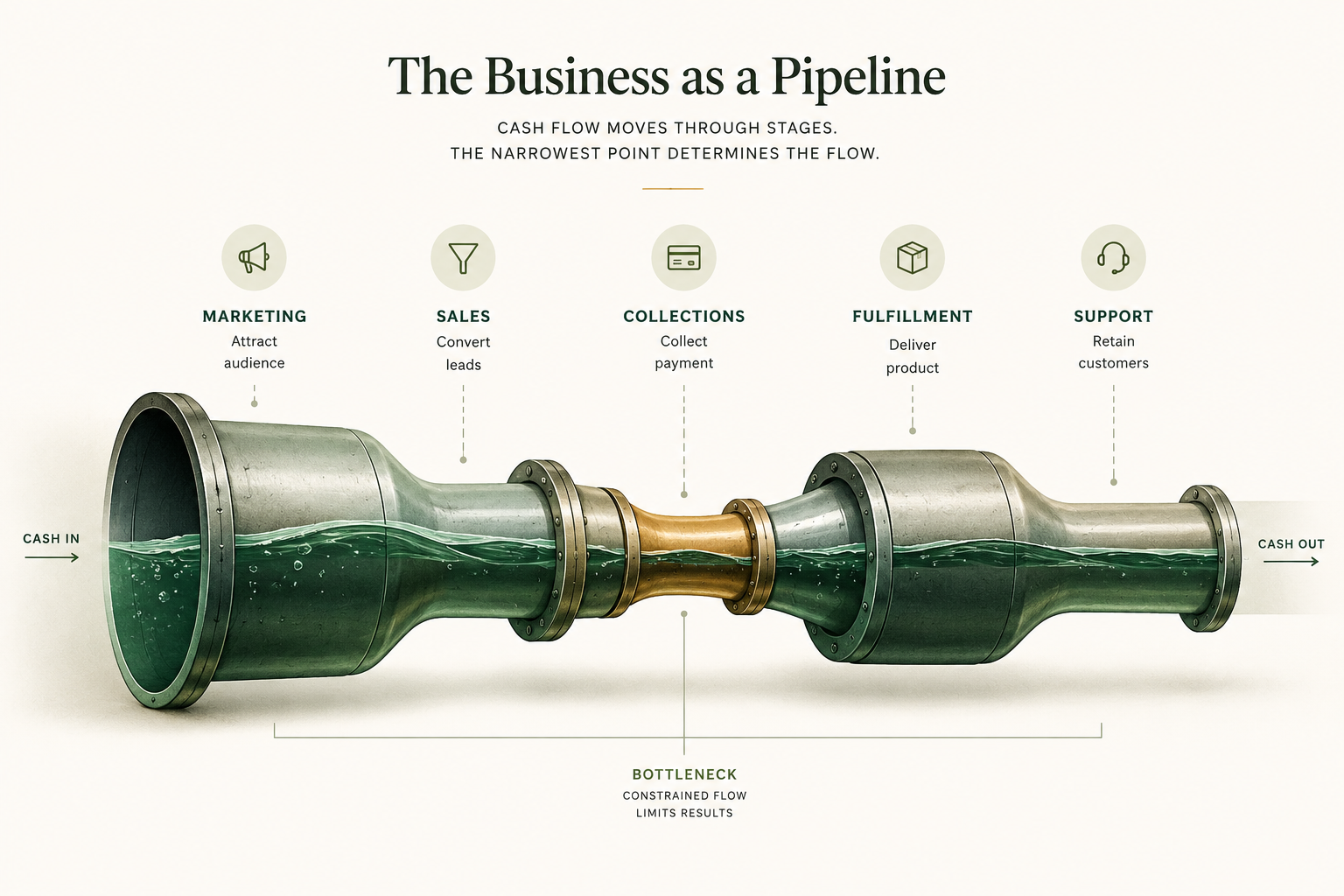
The implication is that automation applied to the wrong stage does very little, no matter how well it is built. Before asking what to automate, the more important question is: where in the pipeline is the constraint? Revenue flows through a sequence of stages, from attracting an audience, to converting them, to collecting payment, to delivering, to retaining, and at any given time, one of those stages is throttling everything downstream. That is the stage worth fixing first. The pipeline chart below makes this concrete.
The Business as a Pipeline
A useful frame for identifying where to focus is to think of the business as a pipeline. Revenue flows through stages, attracting an audience, converting leads, collecting payment, delivering the product, retaining customers. At any given time, one stage is the bottleneck. That is where automation effort should concentrate. Fix the constraint, and the next one becomes visible.
  MARKET AUDIENCE
         |
         v
  +-------------+    Signal:  low inbound leads, low web traffic
  |  MARKETING  |    Automate: content scheduling, SEO drafts,
  +------+------+              ad performance reports
         |
       leads
         |
         v
  +-------------+    Signal:  low lead-to-customer rate,
  |    SALES    |             slow or missed follow-ups
  +------+------+    Automate: lead scoring, auto-reply + booking,
         |                     CRM data entry
   intent to buy
         |
         v
  +---------------+  Signal:  high cart abandonment rate,
  |  COLLECTIONS  |           checkout drop-offs, failed payments
  +-------+-------+  Automate: cart abandonment sequences,
          |                    failed payment retry notifications,
         cash                 checkout reminder emails/SMS
          |
          v
  +---------------+  Signal:  long delivery times, stockouts,
  |  FULFILLMENT  |           high order error rate
  +-------+-------+  Automate: inventory sync, restock alerts,
          |                    shipping notifications
     customers
          |
          v
  +-------------+    Signal:  high inbound ticket volume,
  |   SUPPORT   |             rising churn rate
  +------+------+    Automate: FAQ chatbot, ticket routing,
         |                     escalation alerts
     retention
         |
         v
        [CASH]
Finance, HR, and procurement sit outside the pipeline as infrastructure, supporting every stage but rarely the primary bottleneck. They surface as constraints when operational chaos (unreconciled books, understaffing, vendor delays) slows the pipeline stages above them.
The practical sequence: identify which stage is constricted, then use the per-stage matrices below to prioritise automations within that stage. The pipeline tells you where optimization is needed. The matrices tell you what to build first once you know where.
Prioritising Within Each Stage
Once you know which stage is constricted, the next question is which automation within that stage to build first. Two axes guide this:
- probable impact on cash flow (vertical) and
- time to impact (horizontal).
Ease of implementation is a tie-breaker within a quadrant, not an axis.
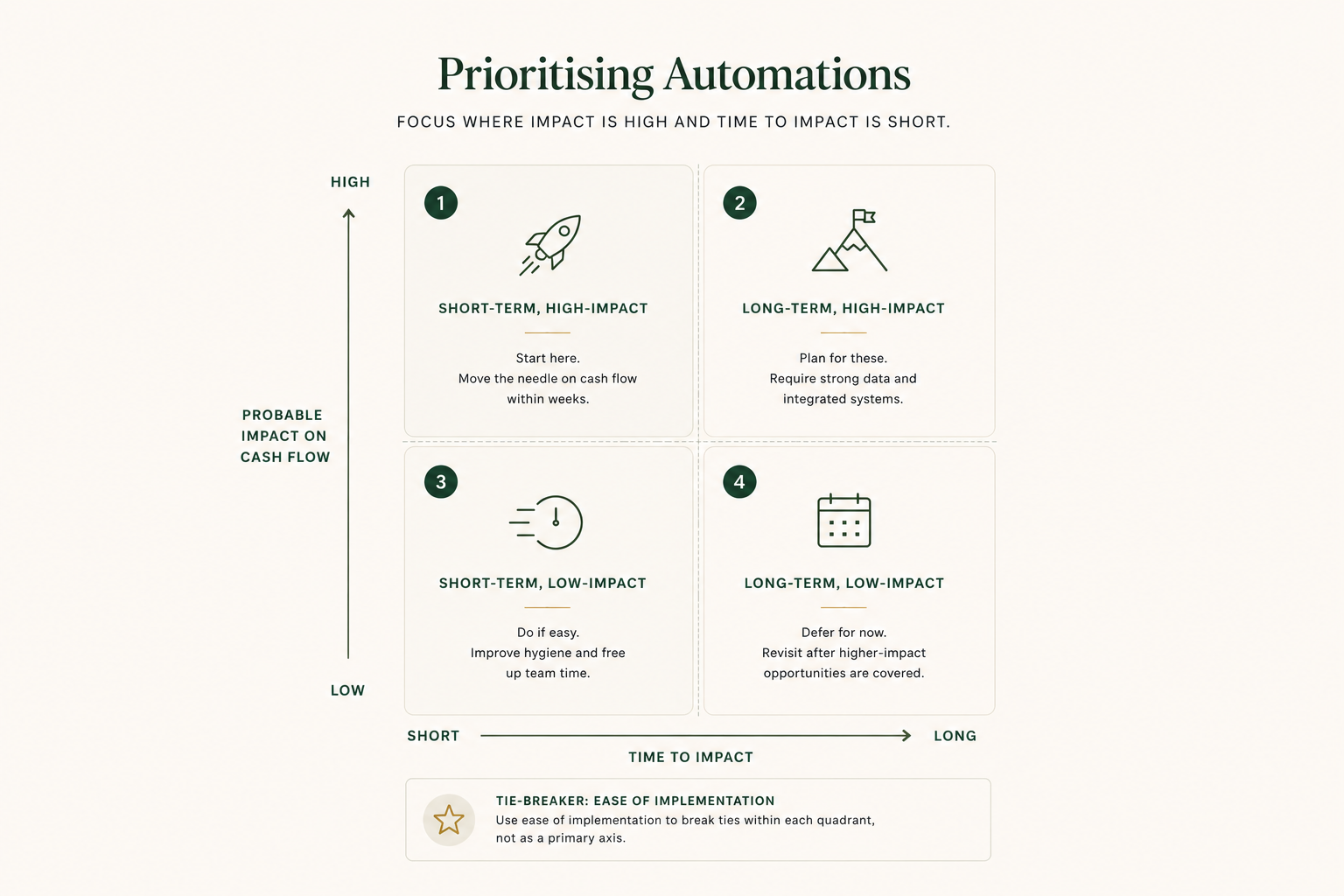
Each quadrant calls for a different posture. Short-term, high-impact items are where to start, moving the needle on cash flow within weeks. Long-term, high-impact items require stable data pipelines and integrated systems; plan for them once the short-term fixes are live. Short-term, low-impact items are worth doing if they cost little, improving hygiene and freeing up team time. Long-term, low-impact items can wait; revisit only after the higher-impact quadrants are covered.
Marketing
Marketing is your bottleneck when your sales team simply has more time on their hands than leads they have to pursue. Ask yourself the question, what actions can I take that will result in high impact, i.e. a large number of leads, in the shortest period of time? This often means looking to optimize existing marketing channels to be more effective, rather than building new marketing channels and systems altogether.
+-----------------------------------+-----------------------------------+
|          SHORT-TERM               |           LONG-TERM               |
+-----------------------------------+-----------------------------------+
|  HIGH  Ad campaign alerts         |  HIGH  SEO content pipeline       |
|IMPACT  Lead magnet auto-delivery  |IMPACT                             |
|        Social post scheduling     |                                   |
+-----------------------------------+-----------------------------------+
|  LOW   Social comment auto-reply  |  LOW   Brand mention monitoring   |
+-----------------------------------+-----------------------------------+
Some examples of short term impact yielding automations are
- Ad campaign alerts - catching underperforming campaigns early stops budget from burning on traffic that isn’t converting. This might not increase leads, but it directly protects ad spend.
- Lead magnet auto-delivery - delivering FREE value immediately (ebook, checklist, template, free guide etc) via a well timed subscription pop-up , converts more visitors into contacts, expanding the top of the sales funnel immediately.
- Social post scheduling - consistent posting grows organic reach at no incremental cost, steadily increasing inbound lead volume over the coming weeks.
In comparison, a fresh SEO content pipeline is likely to take longer time to increase traffic.
Sales
Sales is your bottleneck if a low fraction of leads turn into customers. This implicitly means we have to be tracking leads and conversions. To decide what the optimization should be , we should ask what actions will in the shortest time lead to increased sales.
+-----------------------------------+-----------------------------------+
|          SHORT-TERM               |           LONG-TERM               |
+-----------------------------------+-----------------------------------+
|  HIGH  Lead auto-reply + booking  |  HIGH  Personalised offers        |
|IMPACT  Lead scoring (CRM + web)   |IMPACT                             |
|        Follow-up for stalled deals|                                   |
+-----------------------------------+-----------------------------------+
|  LOW   Meeting reminder emails    |  LOW   Sales forecast dashboard   |
|IMPACT                             |IMPACT                             |
+-----------------------------------+-----------------------------------+
Examples of short term , high impact lead conversion rate include
- Lead auto-reply + booking - responding within minutes while intent is highest increases the probability of a meeting being booked, and a meeting is the first step to a sale.
- Lead scoring (CRM + web) - directing sales effort to the leads most likely to close shortens the sales cycle and increases revenue earned per hour of effort.
- Follow-up for stalled deals - automated nudges on quiet deals recover revenue that would otherwise slip out of the pipeline unnoticed.
Collections/Payment
If an unusually high fraction of visitors to the payment page are not going through with the payment we know something isn’t quite right with the collections process. We can explore what optimizations are needed to reverse this.
+-----------------------------------+-----------------------------------+
|          SHORT-TERM               |           LONG-TERM               |
+-----------------------------------+-----------------------------------+
|  HIGH  Cart abandonment sequences |  HIGH  Subscription auto-billing  |
|        Failed payment retry alerts|        Upsell triggers at checkout|
+-----------------------------------+-----------------------------------+
|  LOW   Order confirmation emails  |  LOW   Loyalty points nudge emails|
|        Payment receipt auto-send  |        Payment preference analysis|
+-----------------------------------+-----------------------------------+
To increase collections, i.e. actual revenue , from those who have shown intent to buy these processes would yield high impact in the short term,
- Cart abandonment sequences - re-engaging shoppers who left without completing purchase recovers revenue that was already within reach.
- Failed payment retry alerts - automatically retrying failed charges and prompting customers to update payment details prevents completed orders from becoming lost revenue.
Fulfillment
This is the actual production and delivery of the product or service. Fulfillment bottlenecks can be either due to supplier delays, manufacturing slowdown or shipping delays.
+-----------------------------------+-----------------------------------+
|          SHORT-TERM               |           LONG-TERM               |
+-----------------------------------+-----------------------------------+
|  HIGH  Multi-channel stock sync   |  HIGH  Demand forecasting model   |
|        Low-stock restock alerts   |        Supplier lead-time tracking|
|        Shipping delay alerts      |                                   |
+-----------------------------------+-----------------------------------+
|  LOW   Shipping confirmation SMS  |  LOW   Carrier performance reports|
|        Order status update emails |                                   |
+-----------------------------------+-----------------------------------+
These are short term high impact yielding processes that could be automated depending on the business status
- Production bottlenecks - identifying which process in the manufacturing of the product is the slowest and is therefore holding up delivery.
- Multi-channel stock sync - keeping inventory accurate across all sales channels prevents overselling, which leads to refunds and erodes customer trust.
- Low-stock restock alerts - triggering purchase orders before a stockout ensures revenue-generating inventory stays available without manual monitoring.
- Shipping delay alerts - proactively notifying customers of delays reduces inbound support volume and prevents chargebacks from buyers who assume their order is lost.
Support
Customer support is becoming the bottleneck if a wait times are high and satisfaction scores of customers are low after interacting with customer support. A satisfied customer base increases the possibility of recurring revenue. This means answering and resolving queries promptly.
+-----------------------------------+-----------------------------------+
|          SHORT-TERM               |           LONG-TERM               |
+-----------------------------------+-----------------------------------+
|  HIGH  Ticket routing by topic    |  HIGH  Support-based churn signals|
|        SLA escalation alerts      |        Knowledge base auto-updates|
|        FAQ chatbot (web + in-app) |                                   |
+-----------------------------------+-----------------------------------+
|  LOW   Ticket auto-acknowledgement|  LOW   Agent performance reports  |
|                                   |                                   |
+-----------------------------------+-----------------------------------+
These are potential processes that can be automated to yield impact in the short term.
- Ticket routing by topic - getting issues to the right agent faster reduces resolution time, which directly lowers the chance a frustrated customer churns.
- SLA escalation alerts - flagging tickets approaching breach prevents the service failures that lead to refunds, credits, or lost accounts.
- FAQ chatbot (web + in-app) - deflecting common questions around the clock prevents frustrated customers from abandoning purchases or cancelling subscriptions.
Conclusion
In conclusion, we’re very much living through an age of AI Hype. Agents make a lot of things possible. But automating naively is in fact the wrong move. Instead companies might benefit more from seeing this as an opportunity to review their business processes, identify bottlenecks , optimize first and only if it makes sense, automate.